The 1921 Discovery That Changed Signal Hill
Before June 1921, the hill rising sharply above the Long Beach coastal plain was cattle country. Ranchers knew it as part of the old Rancho Los Alamitos grant – a windswept promontory useful mainly for its views.
That changed on June 23, 1921, when the Shell Oil Company struck oil at Alamitos No. 1, drilled near the hill's eastern base. The well blew in with extraordinary force, producing an estimated 590 barrels on its first day alone.
Geologists had suspected oil might exist beneath the Los Angeles Basin, but nothing confirmed the scale of what lay underground until that strike. Alamitos No. 1 proved the Signal Hill anticline was sitting atop one of the richest petroleum deposits in California. Word spread fast, and lease brokers were reportedly on the hill within days.
Porcupine Hill and the Race to Control the Boom
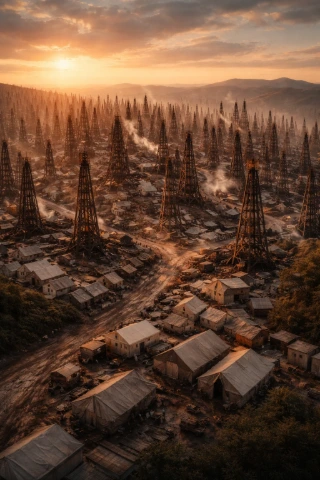
Derricks went up so fast after June 1921 that locals stopped counting. Within two years, more than 250 oil rigs crowded the hill's roughly 500 acres, standing so close together their timbers nearly touched. Photographs from 1922 and 1923 show a skyline that looked almost absurd – the nickname "Porcupine Hill" stuck immediately and for obvious reasons.
Speculators flooded in alongside major operators like Shell and Standard Oil. Lease prices spiked overnight. Workers slept in tents. Roads turned to mud under heavy equipment traffic, and the noise of drilling ran around the clock.
Residents had little recourse while under Long Beach's jurisdiction. Incorporation as an independent city in 1924 gave property owners and local businesses direct control over taxation, zoning, and municipal services – tools that mattered enormously when oil revenue was at stake.
How the Oil Era Still Shapes Signal Hill Today
Traces of the boom years are still visible across Signal Hill, if you know where to look. A handful of pump jacks continue operating on private parcels, their slow mechanical rhythm unchanged since the 1920s. Temple Avenue cuts through what was once dense derrick territory, and the irregular lot patterns along Hill Street reflect how oil leases, not urban planners, originally divided the land.
Hilltop Park, at the city's highest point, offers the clearest view of the former field's footprint. Interpretive markers there acknowledge the Alamitos No. 1 discovery and the city's industrial origins. The Long Beach Oil Field heritage is also documented at the Signal Hill Civic Center, where photographs from the derrick-crowded peak years line public corridors. There's no denying the city carries that history with both pride and a sober awareness of what a century of extraction left behind in soil, community displacement, and environmental remediation still ongoing today.
Signal Hill Still Carries Its Oil Past
Decades after the last great derrick came down, the story of what happened here between 1921 and the mid-twentieth century remains written into the land itself. Pump jacks still nod steadily along residential streets, a quiet reminder that this small city was once among the most productive oil fields on earth. Hilltop Park sits near the original Alamitos No. 1 site, offering a viewpoint where the scale of that transformation becomes easy to imagine. Street names, historical markers, and the city's own boundaries all trace back to decisions made during the boom years. Anyone who passes through Signal Hill without knowing that history sees only a modest hilltop community. Knowing it changes everything.